KDP Risks: Why Amazon’s Platform Is High Risk for Authors
You are only a single email and automated action away from losing your account forever.
With the introduction of AI-generated novels, illustrated children's books, and more, the rules are becoming more strict and the bar is quickly rising on quality (even if you don't use AI).
Why This is a Huge Risk for Self-Published Authors
Whether AI tools are part of your workflow or not, readers are becoming increasingly more skeptical when it comes to the content they are buying on marketplaces like Amazon.
More and more people are turning against AI and with valid reasons. While I am not staking a claim on pro-vs-anti AI here, I am simply stating my observation after selling books and seeing the sudden change in shopping behavior.
The shoppers are hyper sensitive, and you will typically see reviews such as these:
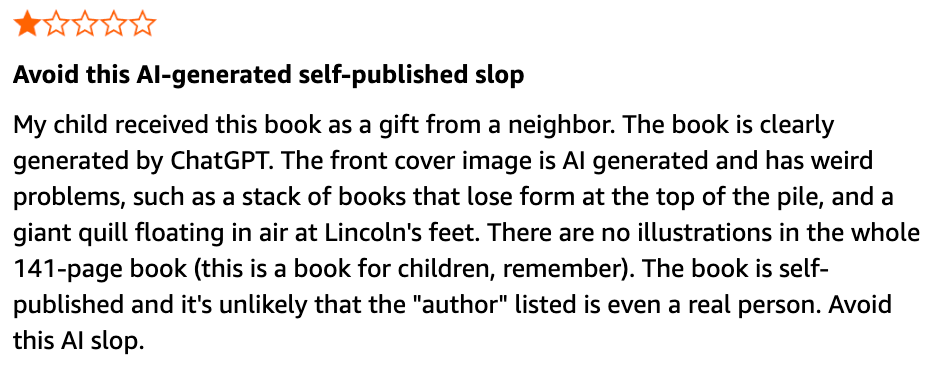
I am not here to debate the quality of the book. What I am simply pointing out is shoppers are super pissed off if they receive a book and it has signs of AI use:

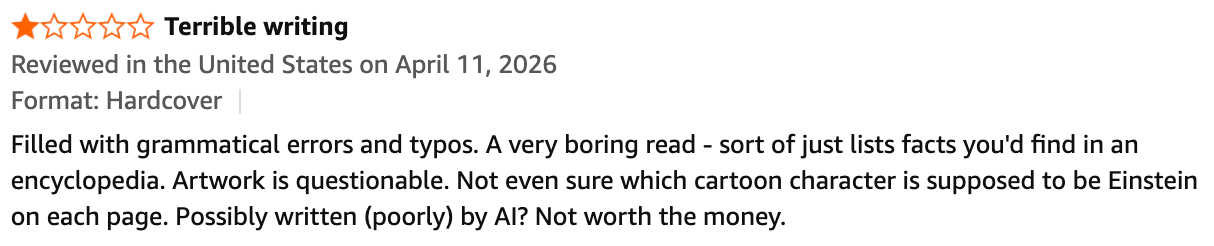
And more, and more, and more...
These reviews from different titles and authors were all "Independently Published", meaning it was published through Amazon Kindle Direct Publishing platform and must adhere to the relevant Terms and Conditions.
Where this becomes a problem is that if you get too many negative reviews / returns, you get a nasty email like this from the KDP account moderation team:
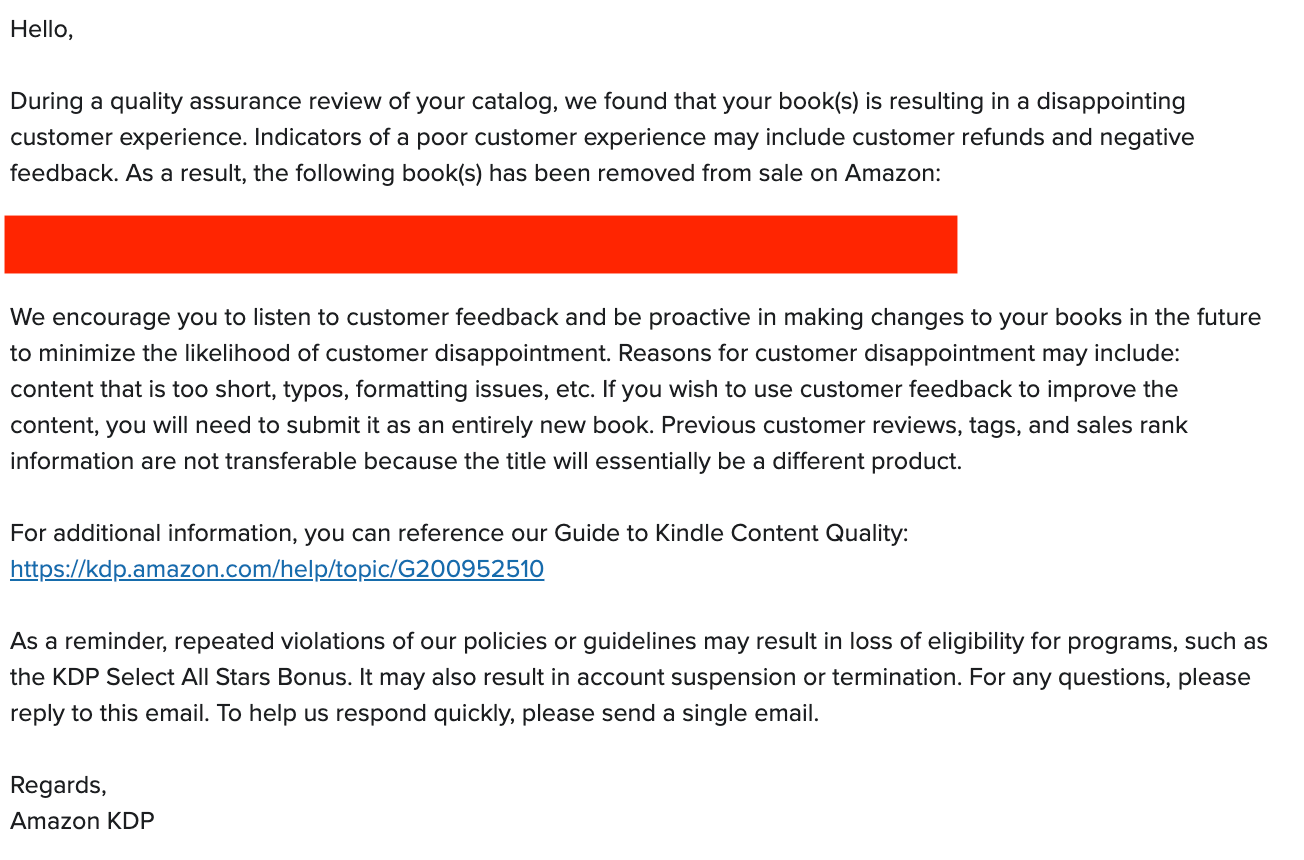
How many before you're kicked out of the program?
I dunno.
Your guess is as good as mine...
Of course we haven't even scratched the surface when it comes to negative campaigns from competitors, disgruntled readers, false copyright claims, or bots targeting your listing.
A single coordinated review bomb can trigger Amazon's automated moderation before any human ever looks at the case.
Oh and don't start down the road of print quality:
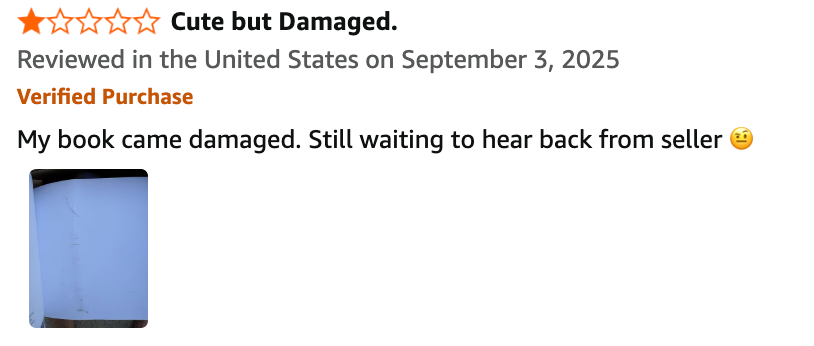
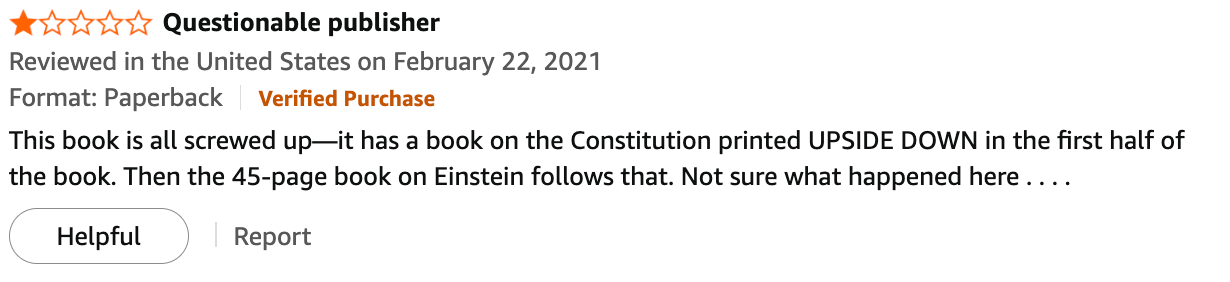
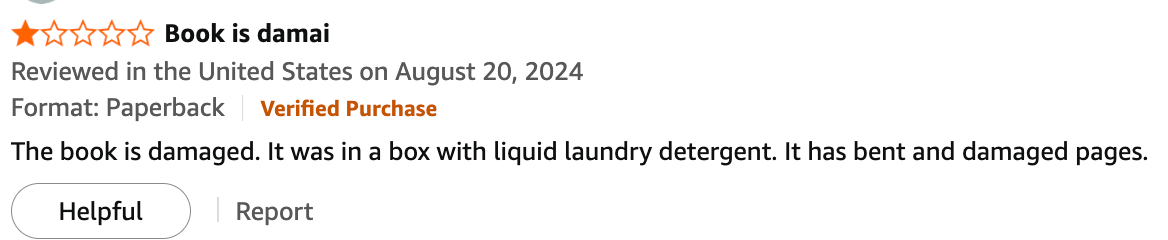
What is your recourse here if you sell via KDP?
Surely you have a contact at the print shop in Amazon to talk to someone...don't you?
While you may think everything is fine when you check your reports daily and see those earnings steadily coming in, that is anything but the case when you rely on a single platform for product quality, distribution, and royalties.
What exactly gets you suspended? Are fake reviews and AI the only triggers?
You've read the Terms & Conditions already right...right?!
Unlikely, but here's some top line items to know that'll get you kicked out:
Amazon's broad discretion
Amazon reserves the right to suspend or terminate an account at any time if it has concerns about the account, activity related to it, or a suspected breach.
Amazon has sole discretion over what content it accepts and can reject or remove books without a specific stated reason.
Account and identity problems
Maintaining more than one account (only one is permitted at a time).
Opening a new account after being terminated. Explicitly prohibited, and doing so without permission forfeits royalties from the new account.
Using false identities, impersonating someone else, or using credentials you aren't authorized to use.
Providing inaccurate, incomplete, or outdated account info (legal name, business details, address, payment info), or failing verification when Amazon requests it.
Letting a third party use your account, or being held responsible for unauthorized activity under it.
Content and rights violations
Publishing content that violates the Content Guidelines / Program Policies (yeah thats a whole other long document).
Not holding the rights to the content you publish (IP infringement, unlicensed material, plagiarism).
Third-party copyright/rights claims against your titles.
Inserting advertisements or promotional content primarily meant to push other products/services.
Breaching the representations and warranties (e.g., defamatory content, privacy/publicity violations, violating any laws).
Manipulation and fraud
Deceptive, fraudulent, or illegal activity tied to your books or account.
Gaming KDP Select — borrows or reads originating from accounts attempting to manipulate the system (bot reads, click farms, etc.).
Review manipulation or otherwise violating Amazon's Community Guidelines.
Attempting to "exploit" KDP or any other Amazon program/service.
KDP Select–specific
Breaking exclusivity. Selling or distributing your enrolled digital book (or a substantially similar one) anywhere else while it's in KDP Select.
Oh But This is Blowing Things Out of Proportion, You're Just Disgruntled...
Yeah, I used to think that too.
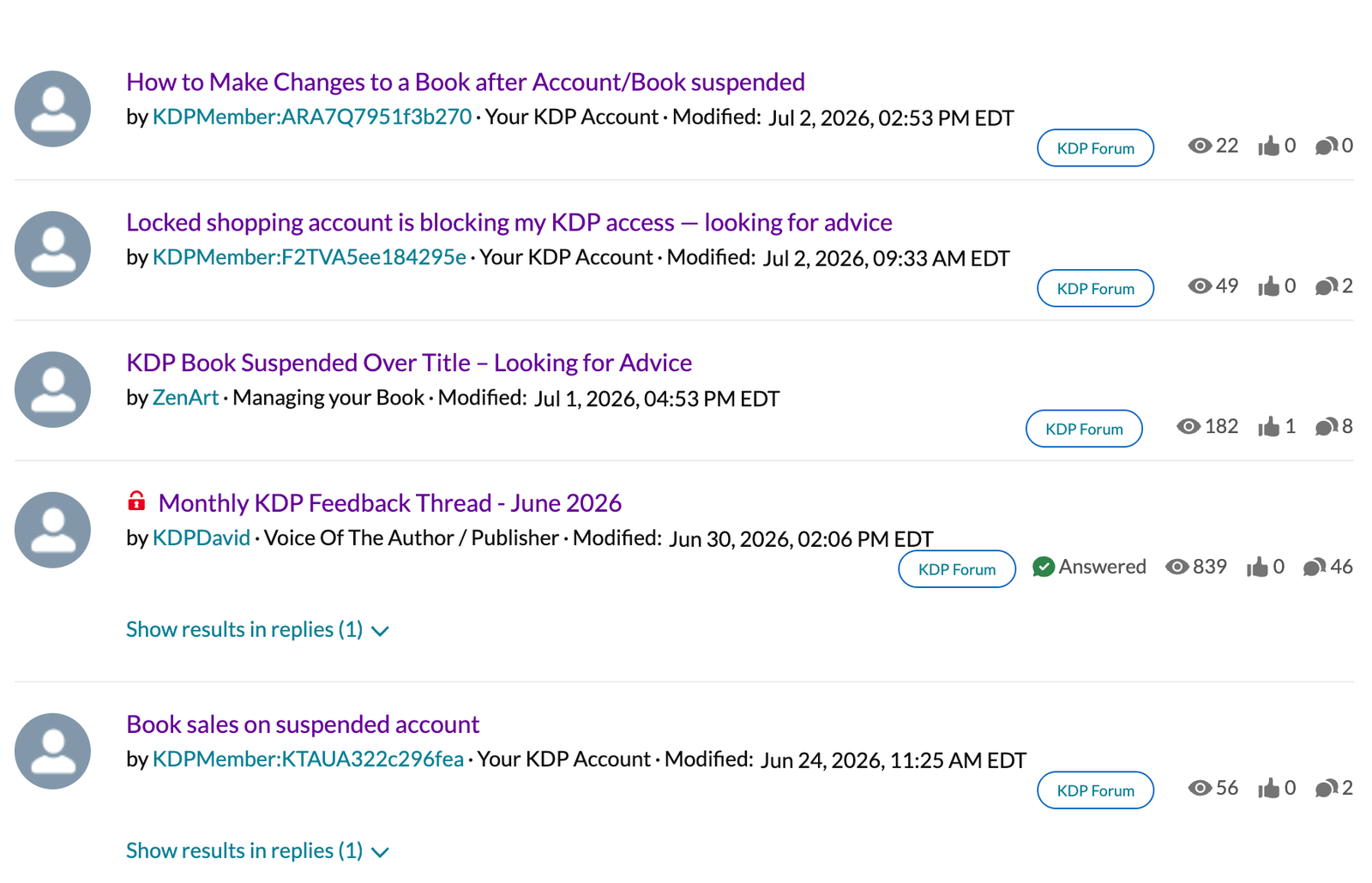
But honestly, one visit to either the "Official" KDP Community or Reddit's /r/kdp and you will see an endless sea of posts around account suspensions:
I'm making good money on KDP right now. Why would I mess with that?
The truth is that it doesn't seem like a problem when you are consistently receiving that sweet sweet royalty check being deposited into your bank account on the last possible business day of every month...until it just...stops.
I would be lazy to make changes too, but the fact remains that you are one policy change or automated flag away from losing everything you’ve built. Why allow your revenue stream to be put at risk when you can start to peel away while everything is okay?
And that’s before we even get to the part that actually hurts the most, the financial hit that nobody talks about until it’s too late.
The Financial Risk that isn't Obvious on KDP - The Cash-Flow Trap
While KDP is terrific for an initial launch of your title, you can quickly get tied to the platform that I liken to velvet handcuffs.
Not only are you beholden to Amazon's platform rules, you don't own the ISBN (to distribute elsewhere), you don't have the customer's information (email), you don't have any way to reach those customers if Amazon decides to remove your listing or suspend your account, and you effectively are powerless and have no recourse against a $2+ trillion organization.
Where it gets really challenging for authors is around the cash flow operations and how tilted the scales are in Amazon's favor.
KDP on average takes 60 days for your current month royalties to be paid.
If you decide to run ads on your book via Amazon ads, you incur that expense immediately.
So there is a constant 60 day window where you are working to catch up to your future royalties.
Here's the kicker:
Should you be found to violate any of the many and extensive T&Cs from Amazon and they suspend your KDP account, those 60 days worth of royalties will not be paid out.
Why You Need to Approach Your Book(s) As a Business
Everybody has a plan until they get punched in the mouth - Mike Tyson
So what's your plan if KDP cancels your account even if everything appears okay?
The point of this post isn't to fear monger, not in the least.
But rather the approach with Amazon should be strictly business and one that you should be aware of the high risk engagement that you are getting yourself into when you sign up for that KDP account.
Simply put when 100% of your business relies on a single platform - that's even worse than putting your eggs into the basket.
You don't own hardly anything but the content file itself.
The customer, the reviews, the ranking, the distribution channel, the physical print – all of it belongs to Amazon. You are renting shelf space, and the lease can be terminated immediately.
That is not a business; it is a dependency.
If you own a book or two, then a KDP account is likely enough and fairly low risk as volume of sales will equally be low.
However, building a series of books or content at scale with a business mindset will provide you with a deeper understanding of what goes into publishing a book, higher margins, more control, and ultimately a significantly better position than relying on a single platform.
You can sell your book direct, but also get it in front of Amazon and their massive customer base, B&N, Apple, Kobo, Etsy, Walmart, and more without fear of retribution.
Not only do you diversify your revenue streams, you also insulate yourself from a single policy change erasing your entire catalog. A competitor complaint that works at Amazon has no power when the book is sold through your site.
A bot that flags your paperback at B&N leaves your IngramSpark hardcover untouched. Each channel becomes a hedge against the others. And because most of those platforms pay faster than KDP, you break out of that 60-day cash-flow trap entirely. The velvet handcuffs only stay on if you let them.
The Soup to Nuts Next Steps
What do you need to impose control on all of this? While it might sound really tough and nuanced, it's surprisingly not. You need the following to set up your own book business and can be ready in a week:
Your own ISBN imprint – not the free KDP one. Buy a block of ten from Bowker (or your country’s equivalent) so you own the identifier and can list the book anywhere.
A direct sales platform – Shopify, Gumroad, Payhip, or even a simple WooCommerce site. You need a place customers can buy from you without Amazon in the middle.
A distribution aggregator like IngramSpark or Draft2Digital – these push your book to Amazon, B&N, Kobo, and libraries while keeping your ISBN and rights intact. You get paid faster and you aren’t locked into one storefront.
If you want full Amazon control, you can sign up for an Amazon Seller account and manage your title that way.
Print on demand once an order comes in via a service like Cloudprinter, StationeryHQ, or Lulu Direct API. Or a local short-run printer that you manage yourself. Keeps you platform-independent and gives you control over trim size, paper quality, and pricing. You can still fulfill Amazon orders through distribution, but you're not dependent on their print arm for your physical copies.
That’s the skeleton. You can set all these up in a week and once they’re running you have a business, not a dependency.
More in KDP
The Self-Published Author’s KDP Launch Day Checklist (2026)
The complete KDP launch checklist, drawn from real self-published author launch reports. 81 steps across 7 phases, interactive progress tracking, and a free printable PDF.
6 min readReadHow to Set Up Amazon A+ Content for Your Book in Just a Few Minutes
Learn how to add Amazon A+ Content to your KDP listings — including comparison tables and image modules — and where to find a free tool that cuts the setup time significantly.
4 min readReadHow to Get Around the Amazon KDP Upload Limit of 10
Amazon's 10-book upload limit applies per format, meaning authors can potentially publish up to 30 titles weekly by strategically using Kindle eBook, paperback, and hardcover slots as separate product lines.
2 min readRead