Mass-Producing AI Books on KDP? Here's the Risk You're Not Pricing In
Using AI to mass produce books on KDP?
You're not alone.
According to Publishers Weekly, the number of self-published print and e-books "soared 38.7% to more than 3.5 million from 2.5 million in 2024."
That bump isn't because a few million people suddenly decided to write their first book. It's that AI models are helping people generate content at a pace we've never witnessed before.
So what does this mean for you and KDP?
Here's the uncomfortable version: your KDP income is only as safe as Amazon lets it be. And the flood of AI books is speeding up the day Amazon decides to tighten the screws.
When content increases at an exponential rate, marketplace dynamics change. Rules get stricter, scrutiny goes up, and the platform starts protecting itself. If you're mass producing books with AI, you're standing right in the path of all of that.
Amazon isn't going to roll over and let AI slop become the standard of its book offerings. While they are a $2+ trillion dollar company that moves a little slower than a 50 person startup, the hammer is coming.
Here's what you should be watching for, and more importantly, what to do so it can't wipe you out.
More Books = More Risk
Every title you publish increases your surface area of risk, because every store listing is one more thing that can go wrong with your account standing.
Each book has to adhere to Amazon's KDP Terms & Conditions, Content Guidelines, Community Guidelines, and Amazon Conditions of Use... plus anything else they decide matters that week.
So if you're publishing 10 books a week (or 30 if you're creatively getting around the weekly upload limit), every one of those titles carries account-level risk.
No one outside of Amazon knows exactly what's being evaluated, but the top-line concern is almost certainly customer satisfaction, and AI-generated books get heavier scrutiny there.
Think along the lines of sale/return ratio, average review score, and the satisfaction metrics Amazon tracks quietly in the background.
You don't see them. Amazon does.
And here's the part most authors miss: a low review average or a high return rate on one title doesn't just hurt that book.
It can potentially flag your whole catalog.
It's not one book that gets you in trouble, it's the pattern across all of them.
So when you upload ten AI titles a week, you're not just publishing books. You're feeding a data stream that can turn against you at any moment.
I've watched this happen.
I published a series that followed the guidelines and reviewed well with customers. One book got removed for a "disappointing customer experience," and within days the moderation team had worked through the rest of the series and started pulling similar titles. I took the remaining ones down myself rather than gamble my account and the 60 days of held royalties on it.
That's the whole point of this section: the risk isn't per book. It's per account.
Accidental Copyright Infringement
LLMs, image models, and audio models are all trained on copyrighted data. The companies behind them claim that's fair use.
Related: Midjourney vs. Disney Lawsuit
But if a model was trained on copyrighted work, it can also reproduce it.
Write a book about a world of wizards and an orphaned boy who goes off to a magical school, and don't be surprised when a name or a location comes out eerily close to something in the Harry Potter series.
Do you want to be on the radar of Bloomsbury's or Scholastic's lawyers?
You'd get a cease and desist, and your KDP account would likely go down with it.
You're the one who hits publish, so it's on you to make sure what you put out doesn't trip over any of the T&Cs or guidelines Amazon can enforce whenever it likes.
Platform Rule Changes Can Happen in an Instant
As AI content keeps accelerating, marketplaces roll out new rules to preserve customer satisfaction, limit abuse, and protect their margins.
Amazon has already been walking the upload limit down for a couple of years. First it was three books a day, then 10 a week. Where it goes next is anyone's guess.
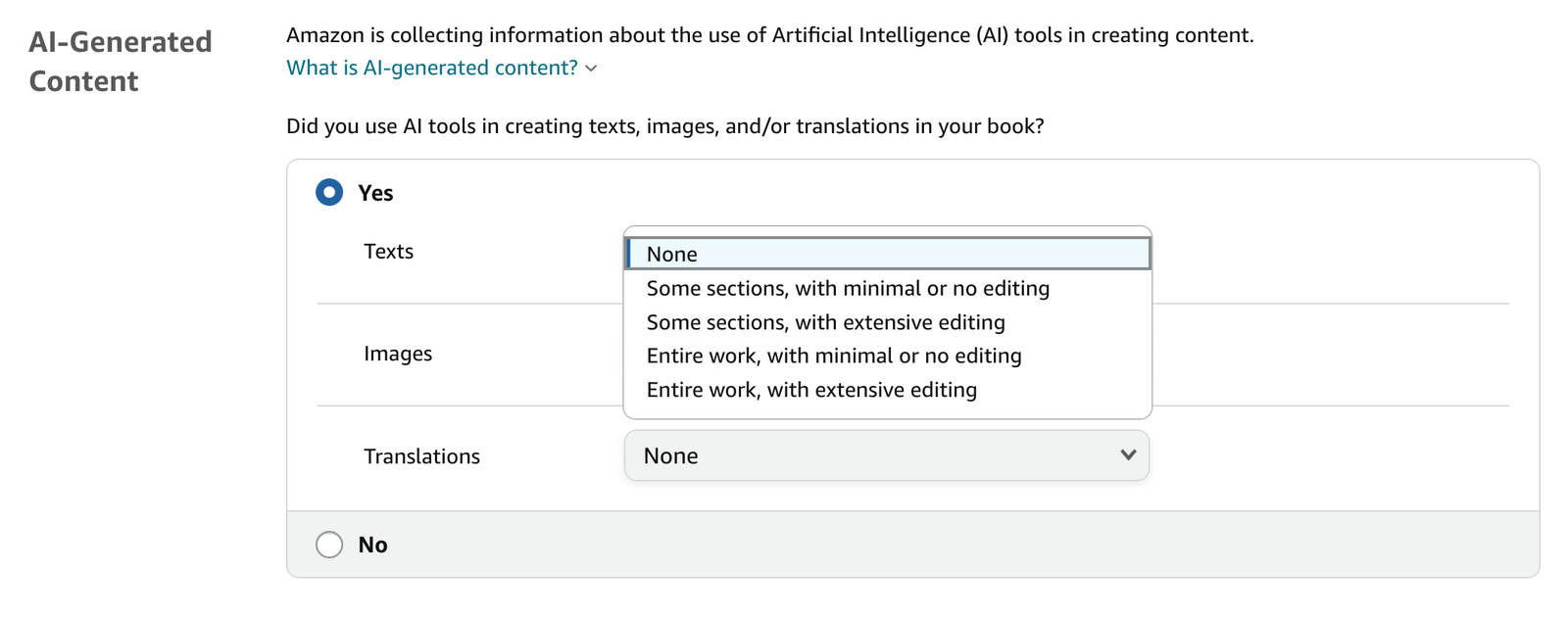
They also make you attest to your AI use, book by book, declaring whether the text, images, and translations were made with AI and which tools you used:
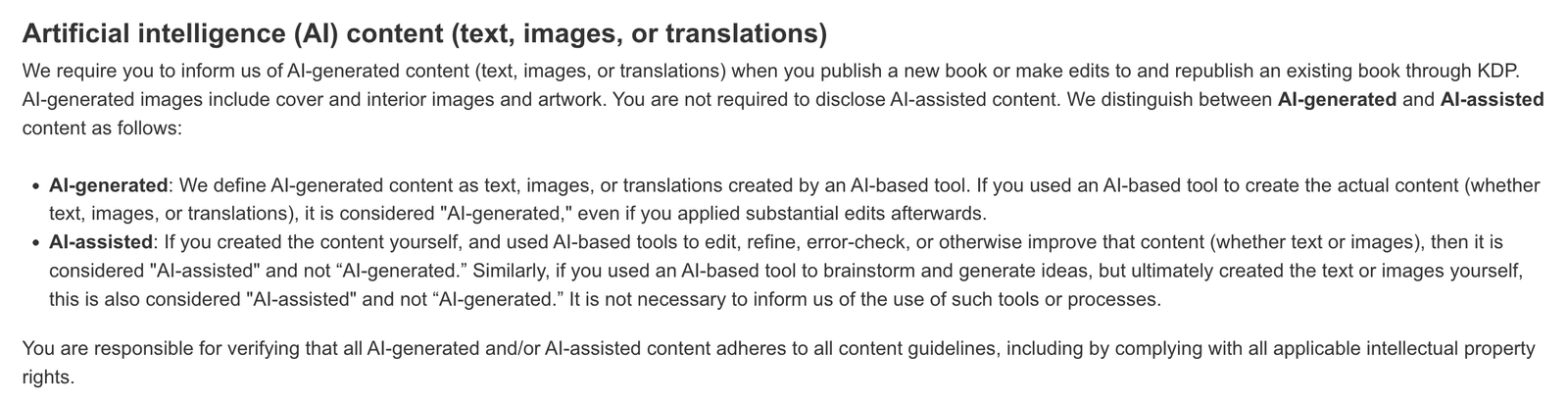
And they've written enough vague language into their Content Guidelines that a support rep can point to something whenever a book gets blocked:
Their platform, their rules.
As I covered at length in this article, KDP is a high-risk platform.
I am not saying its bad - not in the least.
In fact, its among the best in the world due to the sheer size of the marketplace, ease-of-use, and accessibility.
Its just that I wouldn't be shocked if Amazon eventually takes a page from Tidal and stops paying royalties on AI-generated titles altogether. Or quietly limits new KDP sign-ups the way they did with Amazon Merch on Demand.
The point isn't to predict the exact move. It's that the rug can get pulled with no warning, and you don't get a vote.
The Print Quality You Can't Control
KDP print-on-demand quality is rough. Even when you pay up for better paper and covers, customers still receive books that arrive misprinted, damaged, or just poorly made.
And you wear it. A smudged page, a crooked spine, a scuffed cover... the customer doesn't see the print facility's name. They see yours. When that return hits your metrics, Amazon doesn't stop to ask whose fault it was. It's just one more blemish on your record.
This is really a platform-dependency problem wearing a print-quality costume. You're liable for a step in the process you don't control. That alone is a solid argument for moving books off KDP where you can, so you own the quality and the customer relationship instead of renting them.
Dubious Practices (Internal and External)
The more you publish, the more competitors you attract and the bigger the target on your back.
The same way you sized up a niche before entering it, other people are scraping data, watching BSR rankings, and deciding whether it's worth coming after your series. You might not report or review-bomb a competitor. Don't assume everyone in your neighborhood plays by that rule.
Here's one that stuck with me.
I'd written a book about a notable person. The day they passed away, the category flooded with new titles and my book got pulled.
Same day.
It took weeks of back and forth with Amazon before they restored it.
I never found out whether a competitor reported it or someone inside Amazon flagged it - but it was SUPER fishy...
A recent Bloomberg piece makes the second option less far-fetched than it sounds: there are people on the inside who can tip the scales, and usually not in your favor.
"Yeah, But I'm Making Good Money Right Now"
Fair. A lot of people are, and I'm not going to pretend otherwise. You can absolutely pull a solid paycheck from AI-generated books today.
The problem is what that paycheck is built on, and how quickly the ground moves.
Every month, the niches and sub-niches fill up with 10x variants of the same mundane topics. When supply explodes like that, rankings and prices compress, and the easy money in a category dries up faster than you can spin up the next batch. You're not building an asset, you're racing an ever-shorter clock.
The best way I can visualize this is with one of my favorite Wallace and Gromit gifs:

You're racing against Amazon's rules, your competitors, and yourself.
Then there's the customer...
People are fine with AI helping.
They are not fine with AI replacing the creative or knowledge work they thought they were paying for, and books sit squarely on the wrong side of that line for a lot of readers. Publish something with obvious AI "tells" and you'll get a steady drip of one-star reviews, which feed right back into the account-level metrics that decide your fate.
And the economics quietly get worse. When a print-on-demand book is returned, Amazon eats the cost. Stack up enough returns and disappointed customers, and Amazon has every incentive to swing the ban-hammer harder to protect its own margins.
So yes, it works right now. It works the way a trade works right before it gets crowded. The window is real, but it's a window, not a foundation.
What are the early warning signs Amazon is about to ban my account?
The clearest signal is that vague, unhelpful "disappointing customer experience" notice. It never tells you what actually went wrong, whether it's print quality, poor reviews, AI use, or something else entirely.
My rule: if I get that notice on two books in the same series, the whole series comes down IMMEDIATELY.
Losing the revenue stings, but it's not worth risking the entire account and the 60 days of royalties Amazon is still holding for you. If the series was genuinely performing, I'll rework it enough to stand on its own, improve it, and relaunch it somewhere off KDP rather than feed it back into the same risk.
If my account gets suspended, can I appeal and get it back?
I've never taken a permanent suspension myself, so this is based on what people report in places like the KDP Community forums and Reddit's r/KDP. The consensus there is grim: permanent suspensions are rarely reversed, especially when the catalog was all AI-produced.
And no, you can't just spin up a fresh account. Amazon's KDP Terms & Conditions are explicit:
If we terminate this Agreement because you have breached your representations and warranties or our Content Guidelines, you forfeit all Royalties not yet paid to you. If after we have terminated your account you open a new account without our express permission, we will not owe you any Royalties through the new account.
Beyond the forfeited royalties, they tie accounts together through IP address, bank account, tax ID (SSN or EIN), mailing address, and content metadata. A second account usually just gets caught and closed too, so it's rarely worth the effort.
What if I only use AI for editing, cover art, or outlines? Is that safe?
I'm not a lawyer, but this lighter use is generally accepted, and it's the difference between "AI-assisted" and "AI-generated" in KDP's own guidelines. Here's how they draw the line:
If you created the content yourself, and used AI-based tools to edit, refine, error-check, or otherwise improve that content (whether text or images), then it is considered "AI-assisted" and not "AI-generated." Similarly, if you used an AI-based tool to brainstorm and generate ideas, but ultimately created the text or images yourself, this is also considered "AI-assisted" and not "AI-generated." It is not necessary to inform us of the use of such tools or processes.
One catch worth knowing: AI-generated cover art isn't copyrightable, and it likely falls outside that "AI-assisted" definition, which pushes it into "AI-generated" territory. That's a distinction you have to self-attest to when you publish or update a manuscript, so don't assume the cover gets a pass just because you drew the line at "assisted" for your text.
So What Do You Actually Do About It?
Stop treating KDP as the business. Treat it as one channel of the business.
Everything above comes down to the same root problem: your income is sitting on a platform that can change the rules, absorb your returns, and close your account without a real conversation. The fix isn't to abandon KDP. It's to stop being at its mercy.
A few moves that actually change your position:
Spread your titles across other stores. Kobo, Apple Books, Barnes & Noble, and Google Play all reach readers Amazon doesn't own, and an aggregator like Draft2Digital can push a book to most of them without much extra work. If one platform pulls a title, you're not down to zero.
Own a channel nobody can suspend. A simple storefront (through something like Shopify, Payhip, or Gumroad) lets you sell direct, keep more of the money, and control the quality and the customer experience end to end. No POD lottery, no silent metrics deciding your fate.
Build an email list from day one.
This is the big one.
A list is the only audience you truly own. Platforms rent you attention and can revoke it. A list you take with you anywhere, and it turns a one-time buyer into someone you can sell your next book to directly.
Think of your business as layers: the marketplace, the print partner, the payment collection, the audience. When each one is its own layer instead of all being "Amazon," a problem in one doesn't take down the whole thing. That's what makes you nimble as an author and durable as a business.
You don't have to do all of it this week. But if everything you've built lives and dies inside one account, that's the first thing to fix. KDP is a channel, not your business, and the people who keep the money in this window are the ones who treat it that way.
More in KDP
The Self-Published Author’s KDP Launch Day Checklist (2026)
The complete KDP launch checklist, drawn from real self-published author launch reports. 81 steps across 7 phases, interactive progress tracking, and a free printable PDF.
6 min readReadHow to Set Up Amazon A+ Content for Your Book in Just a Few Minutes
Learn how to add Amazon A+ Content to your KDP listings — including comparison tables and image modules — and where to find a free tool that cuts the setup time significantly.
4 min readReadHow to Get Around the Amazon KDP Upload Limit of 10
Amazon's 10-book upload limit applies per format, meaning authors can potentially publish up to 30 titles weekly by strategically using Kindle eBook, paperback, and hardcover slots as separate product lines.
2 min readRead